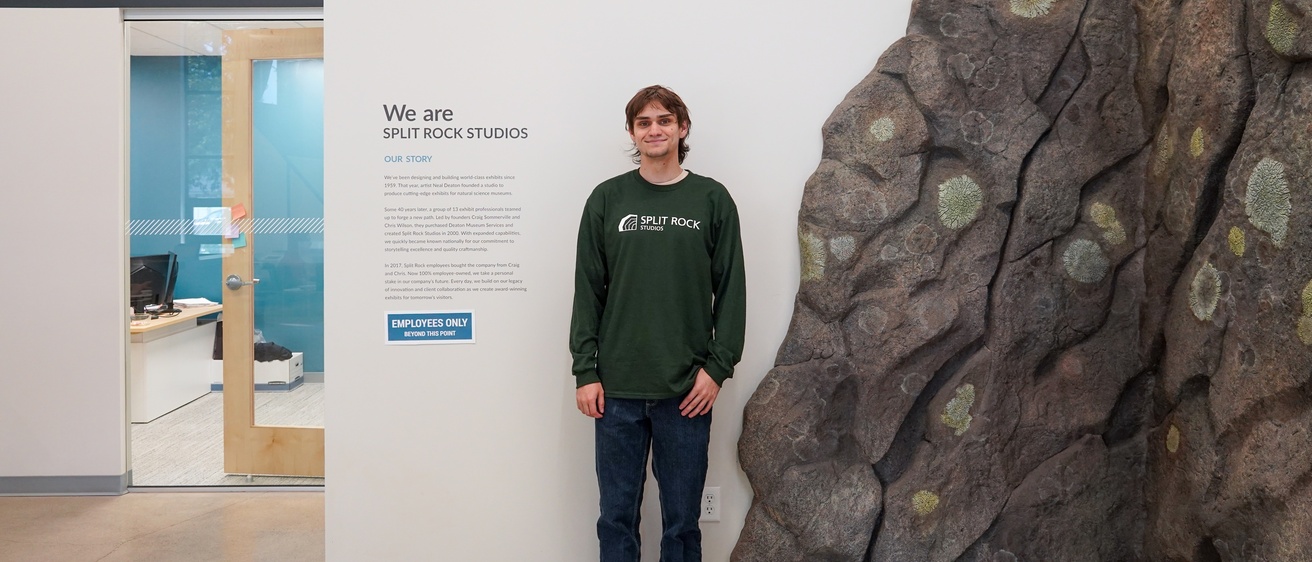
Sam Akerman-Knopf always knew he wanted to build things. Not just design them on a screen, not just manage them from a desk — actually build them, wire them up, watch people interact with them. After graduating from the University of Iowa College of Engineering with a degree in Mechanical Engineering, and spending time in the workforce, he found exactly that kind of role. Today, Sam is the Interactives Engineer at Split Rock Studios in Brooklyn Park, Minnesota, a company that designs and fabricates custom exhibits for museums, nature centers and zoos, universities and libraries, and brands across the country. The path that brought him there runs straight through Protostudios.
A New Kind of Engineering Job
Split Rock Studios is not your typical design firm. The company — one of only a few like it in the entire country — handles everything in-house: concept development, graphic design, CAD modeling, fabrication, and installation. Every exhibit is custom. Every project is a new story to tell.

As the company’s first-ever Interactives Engineer, Sam sits at the intersection of all of it. He’s the connective tissue between the creative and the mechanical — translating a designer’s vision into something the builders can actually make.
The Protostudios Blueprint
When Sam started searching for jobs after graduation, he wasn’t looking for a title or an industry — he was looking for a feeling. Specifically, the feeling he’d had working at Protostudios.
Protostudios, the University of Iowa’s student-run design and fabrication studio, gave Sam something that a classroom alone couldn’t: exposure to a real, end-to-end creative process. He learned CAD modeling in Fusion 360, operated CNC machines, laser cutters, water jets, and 3D printers, collaborated directly with clients, and contributed to projects ranging from medical devices to research tools. His experience shaped his idea of what a great workplace looked like.
So when he found Split Rock Studios online and saw photos of their space, it was an immediate gut reaction.
“I immediately knew that I had to apply,” Sam recalled. “It looked similar to how Protostudios was — big long tables instead of little cubicles. I knew working there would give me a good Protostudios feel.”
Skills That Transferred Directly
The skills Sam developed at Protostudios weren’t abstract — they translated directly and immediately into his work at Split Rock. In his first week full-time, a designer needed help creating a bracket for a motor-driven exhibit. Sam jumped in: designed the bracket in Fusion 360 (the same software he’d used at Protostudios), produced the engineering drawings, and handed them off to the builders.
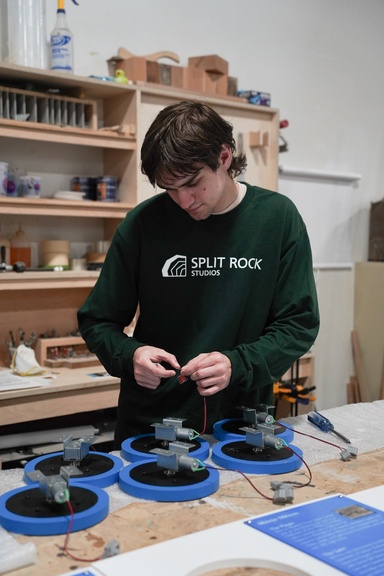
By week three, he had his first solo design challenge: an interactive table where a 3D-printed ship needed to travel along a grooved path. The team had a problem — they didn’t know how to make the ship move the way the design required — and they handed it to Sam with an open brief. He designed a mechanism from scratch, sourced the parts, and is now waiting for the table itself to be built.
Beyond the technical tools, Sam credits Protostudios with building his instinct for problem-solving. Troubleshooting a finicky machine, figuring out how a design translates to the shop floor, knowing when to ask for help and when to just work through it — those habits were formed at Protostudios and are now paying off every day.
Storytelling as a Skill
One of the most unexpected ways Protostudios prepared Sam wasn’t technical at all — it was the ability to tell the story of his work.
For his interview at Split Rock, Sam didn’t walk in with just a resume. He brought his senior presentation from Protostudios and delivered it in full. Rather than listing skills, he walked the team through projects: what the challenge was, how he approached it, what he built, what he learned. He talked about who he was as an engineer, not just what tools he knew.
The response was immediate. Split Rock — a company whose main focus is storytelling through physical, interactive exhibits — recognized one of their own.
“The way you described yourself and your projects is exactly how we like to describe our exhibits,” they told him.
Sam credits Protostudios’ emphasis on presentation — the student highlight videos, the formal showcases, learning to talk about your work — as a defining factor in landing the job.
What He’s Looking Forward To
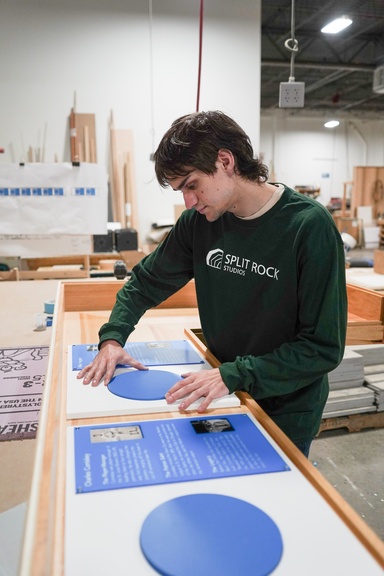
At Split Rock, every exhibit is unique, which means he’s constantly learning something new: a piece of history, a scientific concept, a story worth telling in three dimensions.
He’s most excited for the moment an exhibit gets installed and opens to the public — to see real people interacting with mechanisms he designed and built.
“I think one of the best parts of engineering is just seeing people interacting with the stuff you build,” he said.
It took Sam about half a year of searching before he found Split Rock. He says he wouldn’t have known to look for it — wouldn’t have even known something like it existed — if Protostudios hadn’t first shown him what engineering could look like when creativity and craft come together.
“I never would have found this, or even known to look for something like this, if I didn’t have Protostudios to show me what is possible with engineering.” Sam said.
Sam Akerman-Knopf graduated from the University of Iowa’s College of Engineering and was a Senior Prototyping Engineer at Protostudios during his time at Iowa. He is now based in the Twin Cities, Minnesota.